
They step into a gallery that listens, watches, and responds. LiDAR maps motion, vision sensors read gestures and faces, and spatial audio places sounds exactly where they matter—together they turn passive exhibits into active, memorable moments. You will engage more deeply when these systems work as one, creating seamless, touch-free interactions that feel natural and personal.
This new generation of installations blends precise sensing with smart scene understanding to guide attention, spark curiosity, and support learning. It works across walls, floors, and sculpted surfaces, so every move can change the display, trigger context-aware audio, or reveal hidden layers of content.
Key Takeaways
- Combining depth, vision, and audio creates more natural and personal exhibit interactions.
- Sensor fusion and spatial tracking enable responsive, multi-user experiences.
- These systems increase engagement while keeping interactions touch-free and intuitive.
LiDAR, Vision Sensor, and Spatial Audio Technologies Shaping Interactive Galleries
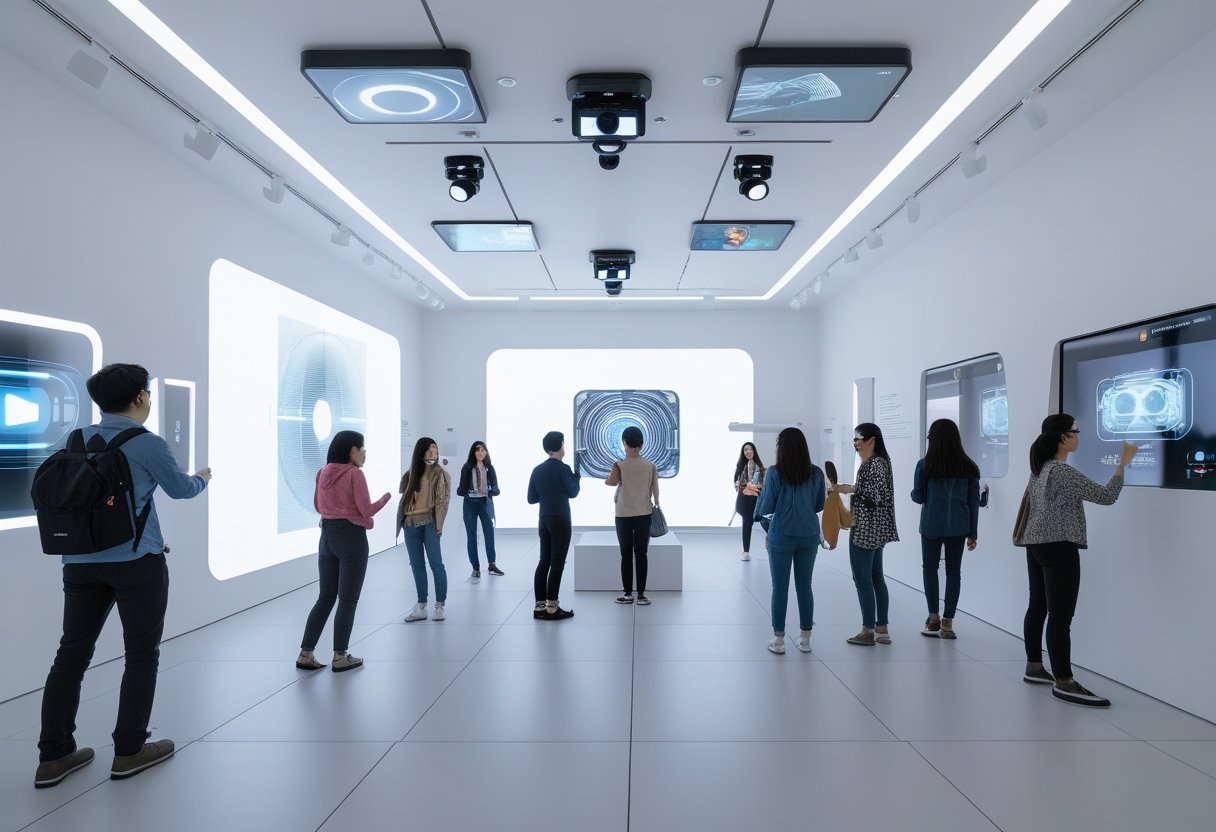
These technologies map space, track visitors, and place sounds precisely. They let galleries turn floors, walls, and objects into responsive zones that react to position, gesture, and group movement.
Principles of LiDAR and Vision Sensor Integration
LiDAR produces accurate 3D point clouds using laser pulses. That gives precise distance and geometry for walls, sculptures, and people. Vision sensors—RGB or RGB‑D cameras—capture color, texture, and fine features that LiDAR cannot see.
Integrators fuse LiDAR point clouds with camera images to get both shape and appearance. Typical steps include spatial alignment (transforming LiDAR coordinates to the camera frame), depth-image projection, and feature matching. Combining laser scan data with visual keypoints improves object recognition and tracking in cluttered gallery spaces.
Practical systems use odometry and pose estimates from LiDAR scans along with visual odometry to stabilize tracking over time. Sensor fusion reduces drift and handles temporary occlusion, so projected content stays locked to exhibits and visitors.
Spatial Audio for Immersive Gallery Experiences
Spatial audio places sound sources at precise 3D locations so visitors hear audio tied to an object or zone. Systems model speaker layout, head position, and room acoustics to render accurate direction and distance cues.
Implementations use head‑tracked binaural rendering for individual listeners or multichannel arrays for group experiences. Galleries measure room impulse responses and combine them with LiDAR room geometry to compute reflections and delays. That lets sound move naturally as visitors walk.
Designers tag audio to objects in the fused spatial map so sound follows an exhibit or shifts when people gather. This tight coupling of point cloud position and audio metadata creates coherent multisensory storytelling.
Sensor Calibration and Synchronization in Gallery Installations
Calibration aligns coordinate frames and timing across LiDAR, cameras, and audio systems. Spatial transforms come from checkerboard patterns, 3D calibration targets, or automated visual‑to‑laser matching routines. Accurate extrinsic calibration maps each sensor to a common gallery coordinate frame.
Time synchronization uses hardware triggers or precise timestamps (e.g., PTP or hardware sync lines) so LiDAR scans, camera frames, and audio events match in time. Without sync, moving visitors produce jitter between visuals and sound.
Regular recalibration and validation against laser scan ground truth prevent drift. Calibration logs should include intrinsic camera parameters, LiDAR range offsets, and measured acoustic response. Together, these ensure reliable sensor fusion, stable projection registration, and tight audio‑visual alignment for consistent visitor interaction.
Multi-Sensor Fusion and Advanced SLAM for Deeper Visitor Engagement
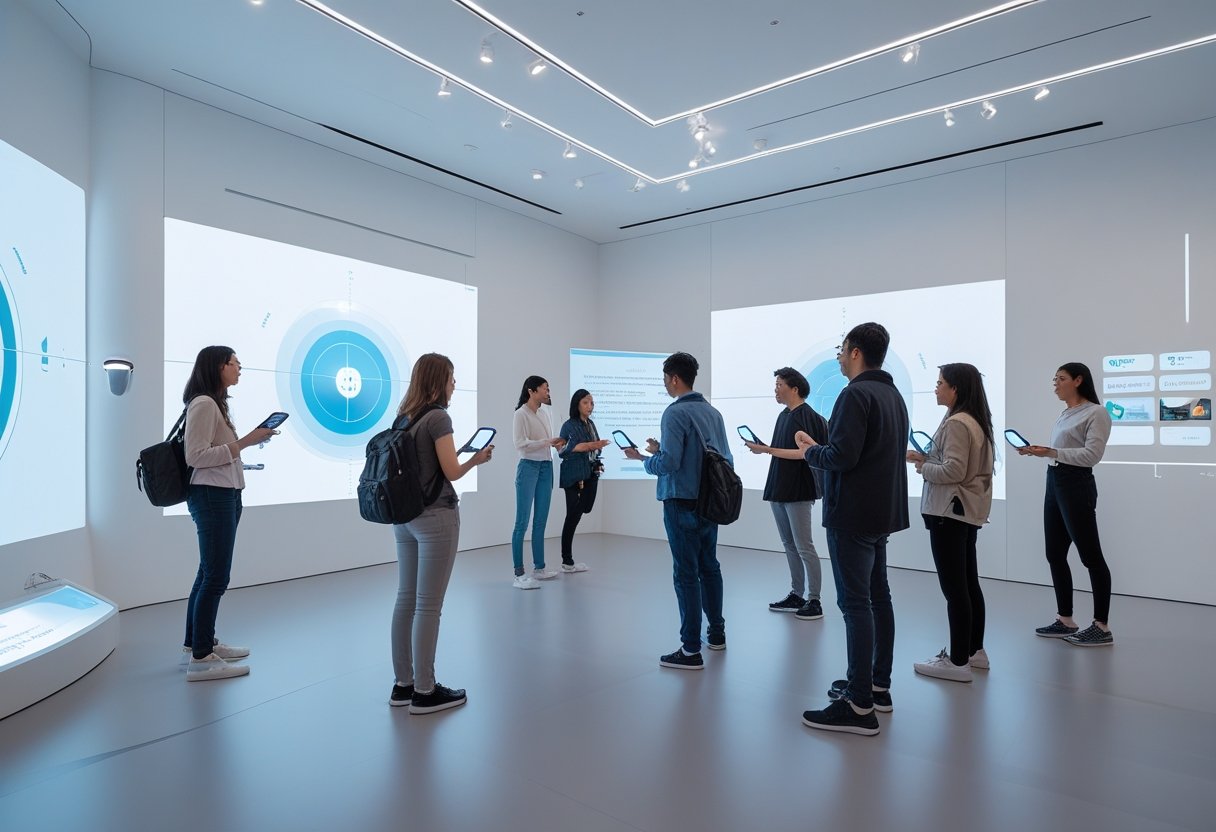
Museums and galleries can use combined sensor data to track visitors, map rooms in real time, and link sound or visuals to precise locations. Accurate pose estimation, fast data association, and removal of moving people let installations respond smoothly.
Simultaneous Localization and Mapping (SLAM) Applications in Arts Spaces
SLAM systems let exhibits know where a visitor is and what they see. Visual SLAM delivers rich color and texture for artwork alignment, while LiDAR SLAM provides precise geometry for room-scale placement. Combining them in a multi-sensor fusion pipeline — for example LIO or visual-inertial odometry — yields stable pose estimation even when one sensor degrades.
Practical uses include: adaptive audio that follows a viewer, AR overlays locked to a painting, and safety-aware navigation for guided tours. Integrating IMU data reduces jitter during quick head turns. Object detection and semantic segmentation help SLAM ignore moving visitors and focus on static displays.
Odometry, Mapping, and Localization in Dynamic Gallery Environments
Odometry computes short-term motion; mapping builds persistent models; localization matches people to that map. In busy galleries, dynamic elements like crowds create moving point clouds and spurious feature matches. SLAM systems must perform robust data association and loop closure detection to avoid drift when visitors block views.
Techniques that help: fusing LiDAR point clouds with camera features, using IMU preintegration to bridge sensor gaps, and applying lightweight deep learning models to label dynamic objects before mapping. Systems often run a fast front-end for odometry and a slower back-end optimizer that performs loop closure and refines pose graphs.
Challenges and Opportunities: Data Fusion, Computational Burden, and Real-Time Performance
Fusing LiDAR, cameras, and IMUs improves accuracy but increases computational burden. High-resolution point clouds and image streams demand CPU/GPU resources and careful bandwidth planning. Real-time constraints require trade-offs: downsampled point clouds, selective keyframe processing, or edge devices that offload heavy optimization to a local server.
Opportunities include using semantic segmentation to prune irrelevant data and applying incremental optimization to limit re-computation. Designers should profile latency for pose estimation, test loop closure reliability in crowded conditions, and choose models sized for on-site hardware. Clear engineering choices keep interactions responsive without overstating hardware needs.