
Your boardroom now has to serve in-room leaders, remote executives, and external stakeholders at the same time, so camera coverage must be accurate, consistent, and unobtrusive.
That shift is pushing you away from fixed framing and toward intelligent systems that can follow the flow of an executive meeting without constant operator input.
Hybrid Governance Expectations
Hybrid governance has changed what a boardroom camera is expected to do.
You need reliable capture of speakers, slides, and room reactions because remote participants are now part of the decision path.
A camera that misses a key comment or obscures a presenter can weaken clarity at the exact moment leadership needs precision.
Executive Communication Standards
Executive meetings rely on presence, tone, and timing as much as the content itself.
A polished video experience signals discipline, which matters when you are presenting to board members, investors, regional leaders, or partners across Indonesia and other markets.
A camera that keeps faces framed cleanly and transitions smoothly between speakers supports the standard of communication that executive teams expect.
How PTZ Auto-Tracking Changes Meeting Dynamics

The biggest change is that the room starts to behave more naturally on camera.
You spend less effort managing the equipment, while remote attendees get a clearer sense of who is speaking, who is responding, and how the discussion is moving.
Speaker Framing Without Manual Control
PTZ auto-tracking keeps the active speaker framed without requiring someone to pan, tilt, or zoom by hand.
That matters in boardrooms where discussion can move quickly between the chair, the CFO, and guest presenters.
The strongest systems feel almost invisible, because they follow movement without making the room feel mechanically staged.
Visibility For Remote Decision-Makers
Remote decision-makers need more than a static wide shot.
They need visual cues that show emphasis, disagreement, and engagement, especially during budgeting, risk reviews, and strategy sessions.
When framing adapts in real time, people joining from outside the room can follow the conversation with less cognitive strain and less need to ask for repeats.
What Leaders Should Evaluate Before Buying
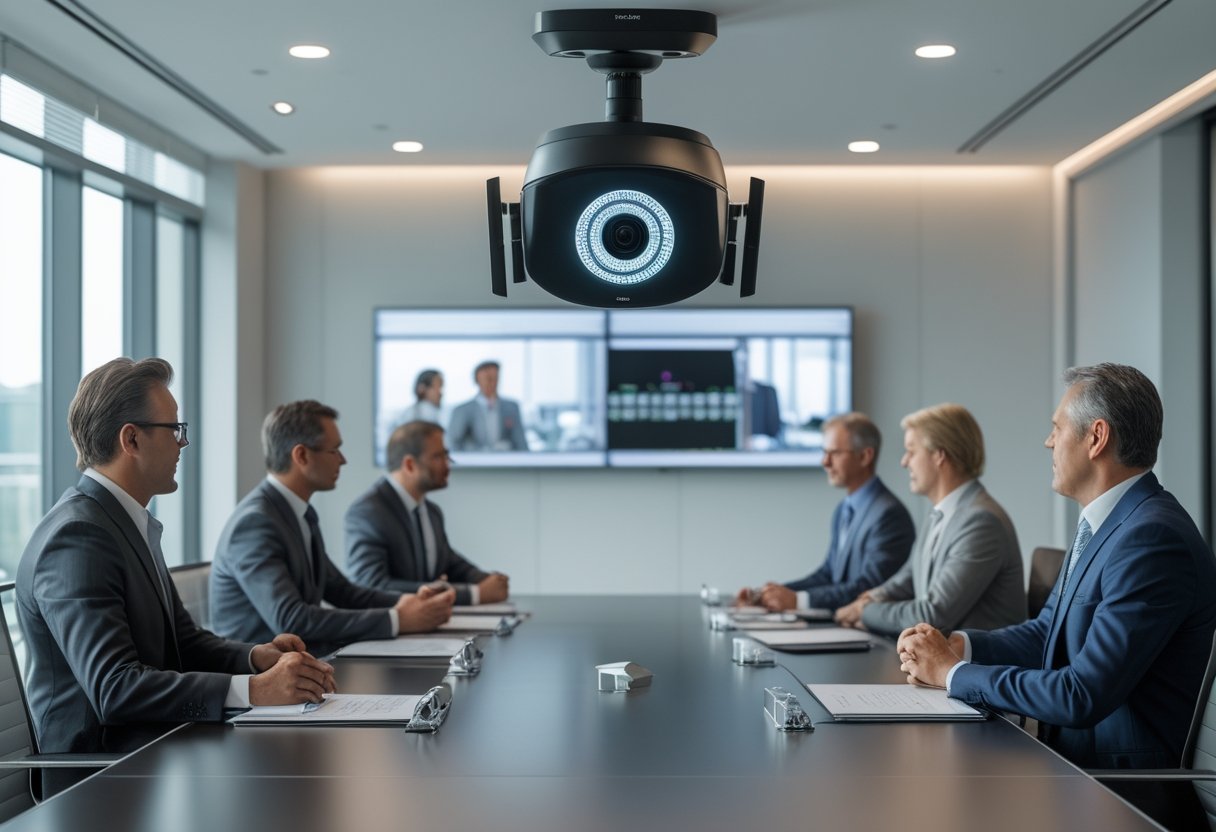
A strong purchase decision depends on more than image quality.
You need to test how the camera behaves in your room, how it connects to your platform stack, and how it handles governance requirements around data and privacy.
Tracking Accuracy In Multi-Speaker Settings
Boardrooms rarely stay quiet and linear, so tracking quality has to hold up when people interrupt, stand, or lean in.
Test the system with real movement patterns, not a clean demo, because auto-tracking can lose confidence when subjects overlap or when someone crosses the frame.
The best models recover gracefully and avoid jitter when speakers switch rapidly.
Integration With Existing AV And UC Platforms
Your camera should fit the rest of your AV and unified communications environment without making every meeting depend on custom workarounds.
Check compatibility with Zoom, Microsoft Teams, Google Meet, and Webex, along with your room control, switching, and display setup.
If the camera needs excessive manual intervention after installation, the operational cost rises fast.
Privacy And Data Handling Considerations
Executive spaces often carry confidential material, so privacy settings matter as much as tracking performance.
You should confirm how the device handles local processing, storage, firmware updates, and any cloud-linked features.
Clear administrative control helps you keep meeting footage, metadata, and access permissions aligned with corporate policy.
Operational Benefits Beyond Video Quality
PTZ auto-tracking delivers value that extends beyond a sharper image.
It can simplify staffing, reduce setup variance, and make your meeting spaces behave more consistently across locations.
Reduced Reliance On In-Room AV Staff
When the camera tracks speakers automatically, you do not need a dedicated operator for every high-level meeting.
That frees AV staff to focus on room readiness, audio health, and troubleshooting rather than constant camera adjustment.
The time savings become more visible as meeting frequency increases.
Consistency Across Global Meeting Spaces
If you run executive rooms in multiple offices, consistency is a strategic advantage.
A common PTZ auto-tracking standard makes meetings feel familiar whether people join from Jakarta, Singapore, or another regional hub.
That consistency also simplifies training, support, and rollout planning across sites.
Common Deployment Risks And Tradeoffs
Automation helps, yet it also introduces new failure points.
You need to weigh the room layout and meeting style against the level of autonomy you want the camera to handle.
Over-Automation In High-Stakes Discussions
In sensitive discussions, too much automation can feel distracting if the camera shifts at the wrong time or frames a speaker too aggressively.
For high-stakes meetings, the ideal setup gives you enough intelligence to stay dynamic while still allowing manual override when needed.
That balance preserves authority in the room.
Room Design Constraints
Your furniture layout, ceiling height, lighting, and seating pattern affect tracking quality.
Long tables, reflective surfaces, and obstructed sightlines can make even good systems behave inconsistently.
Before deployment, you should evaluate the room as a camera environment, not just as a meeting space.
Vendor Positioning And Market Direction
The market is moving toward smarter, more software-defined camera behavior.
Vendors are competing on AI performance, deployment simplicity, and the ability to align with enterprise buying standards.
AI-Driven Differentiation
Vendors now position AI as the feature that separates a basic PTZ system from a boardroom-grade tool.
That usually means better subject recognition, smoother composition, and more adaptive framing across different room sizes.
The strongest offerings pair tracking intelligence with low-latency video and straightforward integration, rather than relying on marketing claims alone.
Enterprise Buying Criteria In 2026
In 2026, your buying criteria are likely to center on platform compatibility, security posture, remote management, and supportability.
Price still matters, yet enterprise teams increasingly care about how quickly a system can be deployed, standardized, and governed.
The winning vendor is the one that reduces friction for IT, AV, and executive users at the same time.
The Long-Term Role Of Intelligent Boardroom Cameras
Intelligent cameras are becoming part of the operating model of the boardroom, not just an accessory.
As executive teams normalize hybrid collaboration, the camera becomes part of how decisions are documented, communicated, and experienced.
From Equipment Upgrade To Governance Tool
A PTZ auto-tracking camera can support more than video capture when it gives leadership a consistent record of who said what, when, and in what context.
That makes it useful as a governance asset, especially in meetings where accountability and clarity matter.
The technology shifts from a room upgrade to a control point in executive communication.
Implications For Executive Presence
Executive presence is no longer limited to physical attendance.
If your camera presents speakers cleanly and keeps remote participants engaged, you extend leadership presence across locations without flattening the meeting experience.
Organizations that treat intelligent camera systems as part of their leadership infrastructure will be better positioned for hybrid decision-making in the years ahead.