Why Meeting Environments Shape Behavior
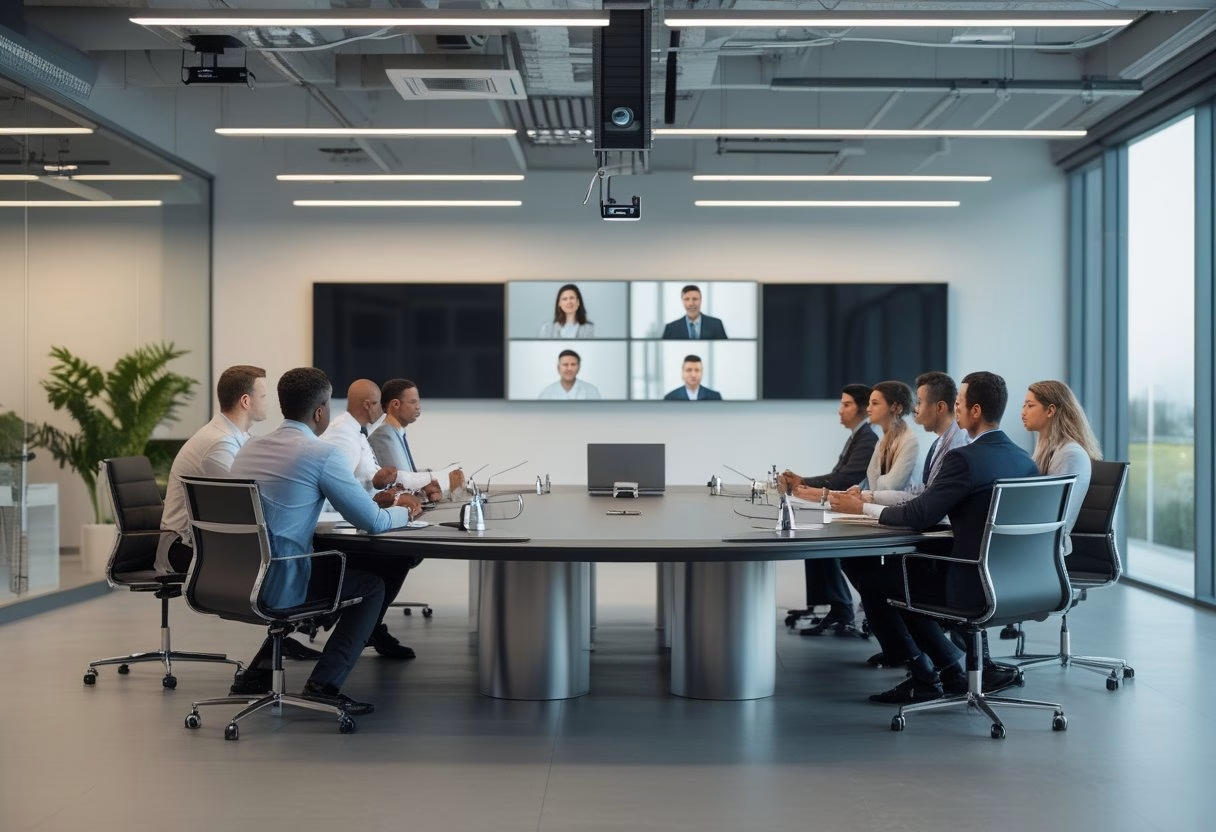
Your meeting room does more than host conversation, it shapes who speaks, who listens, how quickly people decide, and whether the group leaves aligned or drained. In hybrid settings, small AV choices change the social rules of the room, from whether remote participants feel visible to whether in-room participants dominate the pace.
Attention, Trust, And Decision Quality
When your displays, cameras, and audio are clear, people spend less energy decoding the room and more energy evaluating the actual issue. Trust rises when everyone can follow the same signals at the same time, especially in decisions that depend on nuance or disagreement.
In rooms that perform well, the technology stays quiet enough that the team notices the conversation, not the equipment. People interrupt less to fix access, ask for repeats, or compensate for missing context.
The Hidden Cost Of Interaction Friction
Each time someone says, “Can you repeat that?” or “Who is speaking now?” you add cognitive and social friction. In hybrid meetings, that friction often falls hardest on remote attendees, who already have fewer ambient cues to rely on.
Poor AV design also creates behavioral drag in the room. People speak more cautiously, leave gaps in discussion, and avoid fast back-and-forth when they do not trust the system to carry their voice cleanly.
Cognitive Load In Mixed-Presence Collaboration
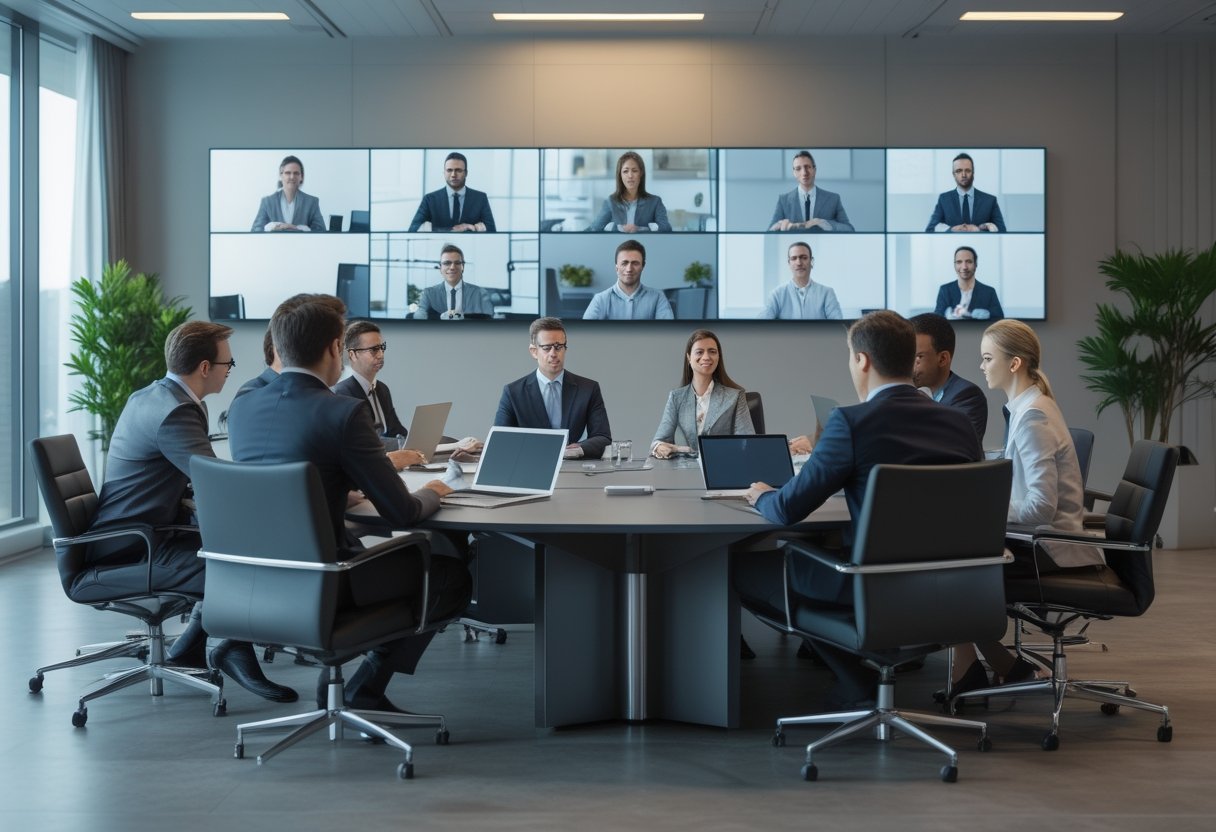
Hybrid collaboration works best when the room reduces mental effort instead of multiplying it. Your AV design should make it easy to hear, easy to see, and easy to track the thread of discussion without constant reorientation.
Audio Clarity And Mental Effort
Audio quality is the fastest way to lower or raise cognitive load. When speech is compressed, uneven, or echo-prone, participants spend mental energy filling in gaps, which leaves less capacity for analysis and contribution.
Microphones, acoustics, and speaker coverage matter as much as the display. A room with clean sound lets people process content rather than spend attention on deciphering words, accents, or overlapping voices.
Visual Complexity And Split Attention
Hybrid meetings fail when your eyes have to choose between the room, the screen, shared content, and side conversations. Every extra visual layer competes for attention, especially when remote faces are small or content is arranged without a clear hierarchy.
The strongest rooms use a simple visual order, with the active content obvious and participants easy to scan. That structure lowers split attention and helps people stay with the discussion instead of constantly searching for context.
Social Presence And Participation Equity
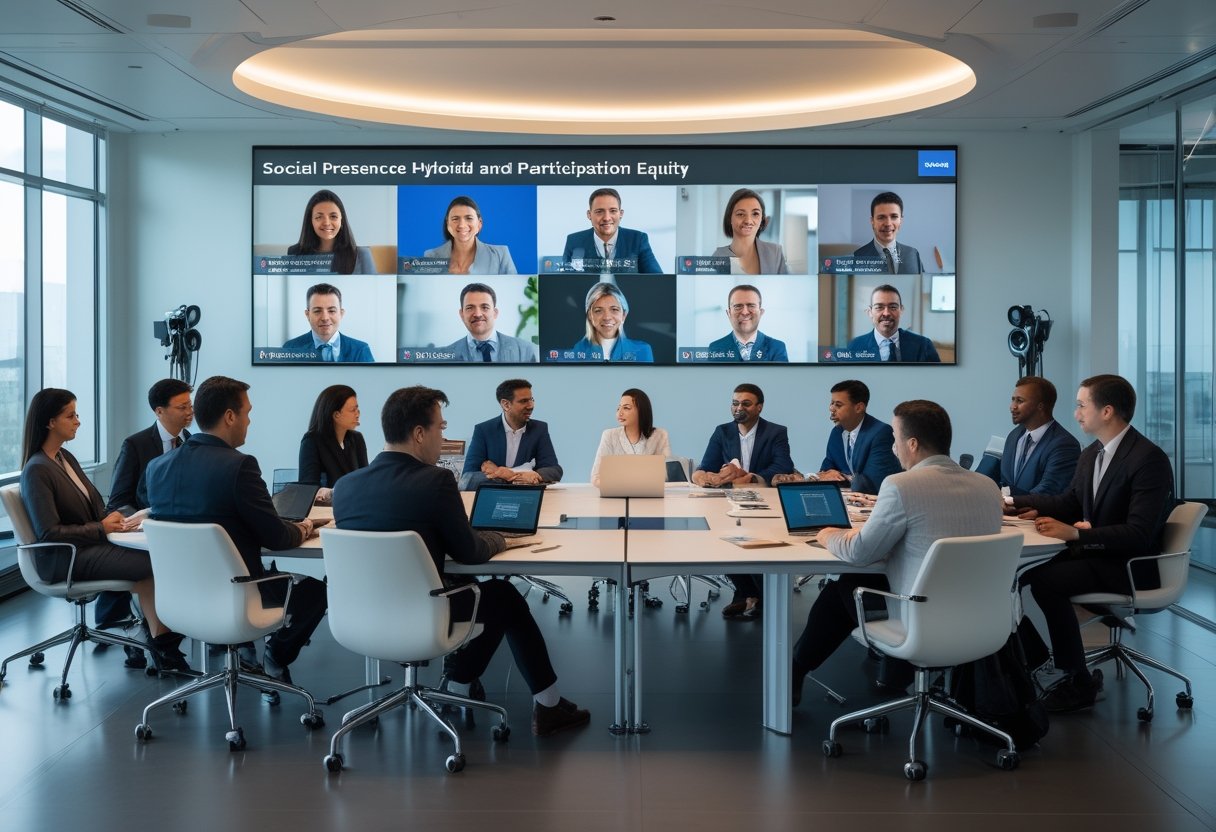
People judge status quickly in hybrid meetings, and your camera framing can reinforce or flatten those cues. If remote participants look secondary or in-room participants visually dominate, the room sends a message about whose input matters most.
How Camera Angles Influence Perceived Status
A camera placed too low can make in-room speakers feel elevated and remote people feel outside the circle. A balanced angle, paired with consistent framing, creates a more neutral social field and reduces the sense that some participants are “in the room” while others are merely observing.
A simple camera adjustment can change the tone of a meeting almost instantly. Once remote faces are visible at a similar scale and level of prominence, turn-taking becomes more equitable and the discussion feels less hierarchical.
Why Remote Voices Get Lost
Remote voices often disappear for structural reasons, not because people are less engaged. If in-room conversation is picked up poorly, if microphones do not capture side comments, or if the room reacts faster to physical presence than to the screen, remote participants lose momentum.
That is an AV design issue as much as a facilitation issue. Equal participation needs equal audibility, clear turn-taking cues, and room behaviors that treat the remote channel as a first-class part of the meeting.
Room Design Choices That Change Outcomes
Your room layout sets the pace of interaction before anyone says a word. Sightlines, display placement, and microphone coverage determine whether people speak naturally, share focus, and move through the agenda without constant resets.
Sightlines, Displays, And Shared Focus
If people cannot see one another and the shared content at the same time, attention fragments. A strong layout keeps faces, screens, and any physical whiteboarding within one coherent field of view, so the group can move between discussion and evidence without losing orientation.
Shared focus also depends on display strategy. One well-positioned screen can outperform multiple scattered displays if it keeps everyone aligned on the same object, at the same time, with fewer visual detours.
Microphone Coverage And Conversational Flow
Conversational flow breaks when only the loudest or closest voices are captured cleanly. Proper microphone coverage supports natural interruption, quick clarification, and the subtle overlaps that make real discussion efficient.
The best rooms make speaking feel effortless. When people trust that their voice will carry, they participate earlier, more often, and with less self-consciousness.
Leadership Signals Embedded In AV Decisions
The AV choices you make communicate what leadership values, even when no one says it out loud. A room designed for inclusion tells people their time and attention matter; a room designed for convenience alone tells them to adapt to the system.
Designing For Inclusion Rather Than Convenience
Convenience often favors the people already in the room. Inclusion asks a different question: can every participant, regardless of location, contribute with equal clarity and equal social weight?
That design choice shows up in practical details, from whether remote attendees can see everyone to whether joining requires a technical workaround. When leadership funds inclusive AV, it signals that hybrid participation is part of the operating model, not a temporary exception.
What Employees Infer From Poor Meeting Experiences
Employees read poor meeting experiences as organizational intent. If people regularly struggle to hear, repeat themselves, or wait for a host to rescue the setup, they conclude that the company tolerates avoidable friction.
That inference affects morale and behavior. Teams become less willing to collaborate across locations, less likely to speak candidly, and more likely to treat meetings as a cost instead of a productive forum.
Measuring Productivity Beyond Technical Uptime
Technical uptime matters, yet it tells you very little about whether the meeting actually worked. Productivity in hybrid collaboration shows up in behavior, momentum, and business follow-through, not just in whether the camera connected.
Behavioral Metrics That Actually Matter
The most useful signals are often simple: how evenly people participate, how often decisions get revisited, how quickly the group reaches clarity, and whether action items are assigned without confusion. You can also track whether remote attendees speak early or only after the meeting is already underway.
Post-meeting behaviors matter too. If people leave with fewer follow-up clarifications, fewer duplicate threads, and less rework, the meeting experience is doing real work for the business.
Linking Meeting Experience To Business Performance
Meeting quality affects throughput. When hybrid meetings are easier to follow, teams make decisions faster, move projects with less delay, and reduce the hidden labor of correcting misunderstandings after the fact.
Sales, product, operations, and leadership all benefit when AV design lowers friction and raises alignment. Better meetings shorten the path from discussion to execution.
Building A Future-Ready Collaboration Standard
A durable hybrid strategy needs more than isolated fixes. You need design principles that can scale across room types, meeting styles, and changing work patterns without forcing every team into the same setup.
From One-Off Fixes To Design Principles
Quick repairs can help, yet they rarely solve the deeper behavioral problem. A future-ready standard starts with principles such as equal visibility, consistent audio, simple sharing, and a room layout that supports the type of meeting you actually run.
That approach also makes procurement smarter. Instead of buying technology for a single room problem, you define what productive hybrid collaboration should feel like, then specify the AV stack that supports it.
Creating Feedback Loops For Continuous Improvement
The best systems improve through routine feedback, not annual review cycles.
Ask participants where attention dropped, where voices got lost, and which room behaviors slowed the meeting.
Adjust the design before the friction becomes normal.
Small iterative changes matter.
When you treat hybrid meeting performance as a living standard, your rooms keep pace with how your teams work.